
Interdisziplinäre Tagung des Forschungsnetzwerks Recht und Religion der Universität Basel: «Konstellationen von Recht und Religion: Interdependenzen revisited»
12. – 13. Februar 2026, Universität Basel
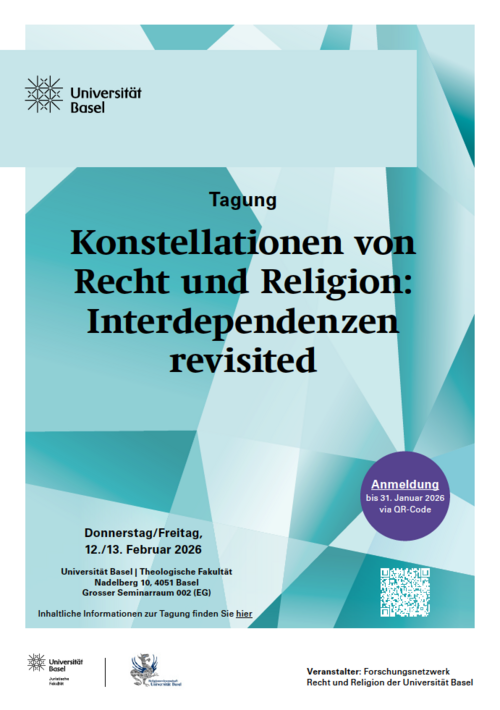
Tagungsprogramm und Anmeldung
Anmeldefrist 31. Januar 2026
Ziel der Tagung ist es, das «und» weiter zu durchdenken, mit dem «Religion» und «Recht» zueinander in Beziehung gesetzt werden: Welche unterschiedlichen Konstellationen sind angesprochen, wenn es um Recht und Religion geht?
Hierfür zielt die Tagung darauf ab, die Verschiedenheit der Konstellationen jenseits gängiger Verhältnissetzungen sichtbar zu machen. Die «Interdependenzen von Recht und Religion», die dem ersten Workshop (2012) und der daraus folgenden gleichnamigen Publikation den Titel gaben, sollen dadurch systematisch weiter aufgeschlüsselt werden.
Im Sinne einer systematisierenden Heuristik, lassen sich vier Formen der Konstellationen zwischen «Religion» und «Recht» unterschieden:
(1) Recht und Religion als getrennte, sich gegenüber, und bisweilen in unterschiedlichem Grade konflikthaft entgegenstehende Felder der Gesellschaft.
(2) Religion innerhalb von Recht bezeichnet die Art und Weise, wie innerhalb eines konkreten (staatlichen) Rechtsystems «Religion» verhandelt, definiert und bearbeitet wird.
(3) Recht innerhalb von Religion zielt auf den Bezug zum Recht, rechtliche Formationen und Praktiken innerhalb konkreter religiöser Traditionen oder Organisationen.
(4) Kongruenzen zwischen dem, was unter den Kategorien Recht und Religion gefasst wird als eine weitere Art der Relation, bei der die Aushandlung der Grenzen und Überlagerungen der beiden Felder selbst zum Thema gemacht wird.
An dieser heuristischen Systematik orientiert sich die inhaltliche Strukturierung der Veranstaltung. Die Unterscheidung der Konstellationen hält die inhaltliche Besetzung der beiden Kategorien «Religion» und «Recht» offen. Beide am empirischen Fall zu spezifizieren vertieft das Verständnis der Vieldimensionalität der diskutierten Relationen. Denn das interdisziplinäre Gespräch zwischen Religionswissenschaft (und angrenzenden Disziplinen) sowie der Rechtswissenschaft zeigt, dass die Vieldeutigkeit des Begriffs «Recht» der Vieldeutigkeit des Begriffs «Religion» in nichts nachsteht.
Referierende:
- Prof. Dr. Andreas Stöckli
- Dr. Emanuel Schäublin
- Dr. Bahman Khodadadi
- Prof. Dr. Marie-Claire Foblets
- Prof. Dr. Nadjma Yassari
- Dr. Anne Beutter
- MA Masha Goldin
- Prof. Dr. Ulrich Haltern
Abstracts der Beiträge
Prof. Dr. Andreas Stöckli
Religionsverfassungsrecht der Schweiz: Aktuelle Dynamiken und Konflikte
Das religiös-weltanschauliche Feld ist in der Schweiz einem tiefgreifenden gesellschaftlichen Wandel unterworfen. Diese gesellschaftlichen Veränderungen können mit den Schlagworten «Säkularisierung», «Individualisierung» und «Pluralisierung» eingefangen werden: Die traditionellen christlichen Grosskirchen verlieren in erheblicher und rasanter Weise an Mitgliedern. Der Bestand jener Personen, die keiner institutionalisierten Religionsgemeinschaft angehören, wächst kontinuierlich. Gleichzeitig hat die religiöse Vielfalt eine Zunahme erfahren, zurückzuführen insbesondere auf Migrationsprozesse. Diese Veränderungen werfen die Frage auf, ob das bestehende schweizerische Religionsverfassungsrecht zukunftstauglich ist. Im Referat sind etwa die folgenden Fragen zu klären: Wie muss die Glaubens- und Gewissensfreiheit gedeutet werden, um dem zunehmenden Konfliktpotenzial im religiös-weltanschaulichen Bereich gerecht zu werden? Ist das Prinzip der religiös-weltanschaulichen Neutralität gegen Infragestellungen zu verteidigen? Mit welchen Herausforderungen ist das institutionelle Gefüge der Beziehungen zwischen Staat und Religionsgemeinschaften konfrontiert?
Dr. Emanuel Schäublin
Lawfulness within and without the state: The role of Islamic legal scholars in armed conflicts
Armed groups framing their struggle in Islamic terms are involved in more than half of all armed conflicts. They often challenge the state by setting up alternative governance mechanisms providing services, protection, and a justice system. Islamic legal scholars anchor the actions of such groups in terms of warfare and governance within legal frameworks derived from the Islamic scriptures (Quran and Prophetic tradition). Islamic law (sharia) is not a defined set of laws. Sharia can be more precisely described as the “right path” through life derived from the Islamic scriptures by authoritative interpretation in view of a specific context and specific circumstances. Drawing on a multiyear research project studying Islamic legal scholars in different intrastate conflicts, this paper will primarily draw on armed groups in Mali and Somalia. It will first illustrate how certain demands for introducing certain interpretations of Islamic law (sharia) are linked to grievances and aspirations of marginalized segments of society. Then it will discuss how Islamic legal scholars play different roles in conflict landscapes (close to armed groups, close to the government, close to communities, and as part of transnational networks). In these different roles, they take part in public debates on governance through sermons, audio recordings, online channels, videos, etc. Scrutinizing this material, the paper shows how a sense of lawfulness derived from the Islamic scriptures can emerge within and without the state (as well as in the places in between). The paper argues that Islamic legal scholars interpret the Islamic scriptures to guide actions in the present. To maintain their legal and moral authority, they need to cultivate a good reputation and trust among their communities and peers. This creates a certain decentralized form of accountability that is particularly relevant in contexts where state institutions are limited or distrusted.
Dr. Bahman Khodadadi
The Non-Execution of Divinely Ordained Penalties: Crisis and Opportunity Through Politico-Juridical Dynamics of Shiʿism
Following the Twelfth Imam’s Occultation (al-ghaybah al-kubrā) in the 4th/10th century, the applicability of divinely ordained punishments (ḥudūd) became a point of contention among Shiʿi jurists, dividing them into pro- and anti-ḥudūd camps. After the 1979 Islamic Revolution and the establishment of a Shiʿi theocracy in Iran, the pro-ḥudūd position gained state backing, resulting in the codification and continued enforcement of ḥudūd punishments within Iran’s Islamic Penal Code. In recent decades, however, some Iranian legal reformers—acknowledging the sociopolitical and doctrinal challenges of implementing ḥudūd—have proposed two politico-juridical mechanisms (zarfiyat) that might allow for their suspension: the secondary ruling (ḥukm-i thānawī) and the state order (ḥukūmat). This talk examines the theological and legal justifications offered for these mechanisms, as well as the criticisms voiced by conservative and orthodox-minded jurists. I argue that these critiques raise significant doctrinal obstacles, ultimately hindering the practical suspension of ḥudūd punishments in contemporary Iran.
Prof. Dr. Marie-Claire Foblets
Religionsfreiheit heute in Europa – kostbarer denn je
Mit der wachsenden kulturellen, religiösen, ethnischen und sozialen Diversität innerhalb der derzeitigen europäischen Gesellschaft ist die Diskussion über die Frage eines angemessenen Schutzes von Religionsfreiheit und Weltanschauung heute lebhafter denn je. Mit dem Argument, dass es aufgrund der per Verfassung garantierten Freiheiten keines speziellen Schutzes der Religionsfreiheit bedarf, plädieren immer mehr Stimmen dafür, diesen besonderen Schutz aufzugeben. Andere hingegen würden es begrüßen, wenn sich auch neu gegründete und/oder nach Europa eingewanderte Religionsgemeinschaften auf denselben verfassungsmäßig garantierten Schutz berufen dürften, der den traditionellen Religionen gewährt wird. So lange bleibt es weitgehend der Justiz überlassen, von Fall zu Fall über den Schutz der Religionsfreiheit zu entscheiden. Anhand konkreter Beispiele konzentriere ich mich hier auf zwei Forschungsergebnisse : 1. die Beobachtung, dass das Fallrecht sehr uneinig ist, wenn es um den Umfang des Schutzes geht, der insbesondere in Glaubensfragen zu gewähren ist; 2. gestützt auf empirische Forschung werde ich aufzeigen, dass religiöse Identität eine sehr spezielle Bedeutung für manche Minderheiten hat und von dem Willen begleitet wird, als Gläubige am aktuellen gesellschaftlichen Leben teilzunehmen. Oft wird dies begleitet von Dilemmata, die selten in der Öffentlichkeit diskutiert oder systematisch untersucht werden.
Prof. Dr. Nadjma Yassari
Eingebettete Normen: Zur Diskursivität islamischer Rechtsproduktion
Islamisches Recht entsteht durch exegetische Methoden und ist zugleich stets sozial eingebettet. Lange herrschte jedoch die These – maßgeblich geprägt von Joseph Schacht –, dass das Recht das eigentliche Wesen des Islam sei. Tatsächlich aber entfaltete sich islamisches Recht immer in seiner Diskursivität und Einbettung – als Tradition, die ihre Lebendigkeit aus der Spannung zwischen Text und Kontext gewinnt.
Dr. Anne Beutter
“To Checkmate the Evil" - Legal Practices in a Christian Religious Organization: Legal in Form, Religious in Function
This paper explores the religious function of legal practices within a West African church by showing how they enact, shape, and justify the church's normative order in a plural religious and legal context. Based on the analysis of minutes of a council of church elders in the Presbyterian Church of Ghana in the 1950s, I examined disciplinary procedures and the related categories and forms of documentation. These practices are formally legal in structure but clearly serve religious ends. The phrase “delinquent members must be dealt with to checkmate the evil” encapsulates the moral urgency and theological efficacy that the church elders ascribe to their activities. These legal forms are mobilized not merely to maintain institutional order but to enact spiritual protection, moral purification, and communal belonging. They are “legal in form, religious in function,” as they operate within a framework that draws from legal rationality—both Western and local—while speaking to religious values and beliefs of divine intervention and protection, spiritual vigilance, and collective sanctification. Drawing on approaches from legal anthropology and everyday history, I engage the constellation of “law within religion” from the perspective of legalist practices at the base of a religious organization. The examined practices realize the church’s normative expectations and make them relevant in everyday life. In doing this, they shape what counts as Christian and thereby situationally demarcate and relate the different normative orders that shape the church members’s lives. Legal practices in religious organizations should therefore not be understood solely as instruments of control or administration but as co-determining the very notion of what the religious organization stands for and how one belongs.
MA Masha Goldin
Eschatology in the Courtroom: Conflating Terrestrial and Celestial Trials
Images of the Last Judgment often served as backdrops for juridical proceedings throughout the European Middle Ages. Monumental depictions of the Final Judgment first appeared in church portals and made their surroundings the preferred location for courts of law held by both ecclesiastical and secular authorities. With the rise of municipalities in the thirteenth century, however, dedicated legal spaces, that is, courtrooms or loggias built specifically for holding trials, appeared for the first time. Representations of the Last Judgment became a standard element of the design of civic legal spaces. While art and legal historians interpreted the Last Judgment imagery created for proto-legal spaces before the rise of municipalities as a means of inviting reflection on the eschatological implications of sin and crime (at a time when their boundaries were loosely defined), Last Judgment depictions in municipalities are usually understood as warnings to the judges: i.e., reminders that they will also be judged for their actions at the end of time. This latter claim will be reexamined in this paper, which will focus on one Last Judgment panel, the so-called Court Tableau of the City Judge Niclas Strobel, probably commissioned for the old town hall of Graz in 1478. It will be argued that the painting was made to address the subjects under the jurisdiction of the civic judge and assert the legitimacy of his authority. By demonstrating how the Graz tableau merged features from contemporary portraiture and Last Judgment representations from juridical spaces, the paper will suggest a new reading of the painting. In particular, it will be discussed as a device whose purpose was to resolve the tension between the judge’s identity as a local citizen and merchant, and his superiority in the courtroom. Reconciling the dual aspects of the municipal judge’s persona, the painting offered its contemporary beholders an argument about the validity of the municipal representative’s right to judge his fellow citizens.
Prof. Dr. Ulrich Haltern
Der Souverän. Homologe Körper in Staat und Kirche
Quick Links
Social Media